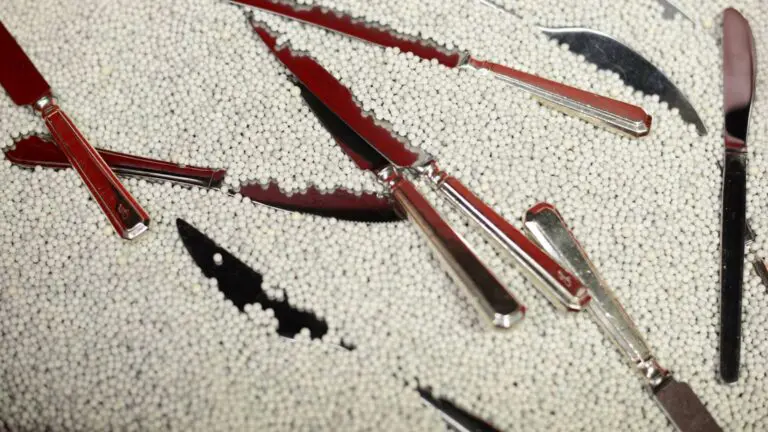
Mass finishing is a key step in finishing a large number of parts.
A mass finishing treatment gives processed parts several advantages:
A flawless finished appearance, superior aesthetic quality and extended durability over time.
You are aware of the importance of delivering perfectly finished parts to your customers.
And is that precisely why you want to invest in a good mass finishing machine?
You also know that by choosing a good machine, you maximize your chances of meeting your customers’ requirements in terms of finish quality.
Even though you know all this, are you still wondering how a mass finishing treatment actually works? Are you wondering how long the process takes and how many parts you can process at once?
To help you see more clearly, we have broken down all the steps involved in mass finishing:
How long does a mass finishing cycle last?
To determine the surface treatment time for your parts, several aspects need to be taken into consideration:
- The nature of the part to be processed
- The initial surface condition of the part
- The state of wear of the abrasive media
- The choice of mass finishing machine
However, there is a quick and easy way to find out this information in advance:
Run tests on sample parts beforehand
These trials will allow you to test, check and, if necessary, improve the process parameters.
However, to ensure that the results obtained during the trials can be reproduced, you will need to make sure that these samples match in every respect the parts you will later process in your workshop.
Once you have completed your first trial, we recommend that you record each step of the process in a logbook.
This logbook will be very useful if you need to carry out more than one trial, and essential to support your decisions on any adjustments to your final mass finishing process.
Once you are satisfied with the results of the mass finishing trials, we advise you to create a data sheet. It should contain the parameters used during the process, the inspection criteria and any other information considered useful to ensure the test results can be reproduced.
Based on all the factors mentioned, a mass finishing cycle can therefore be very short, lasting 10 minutes, or it can last up to several hours for certain types of parts.
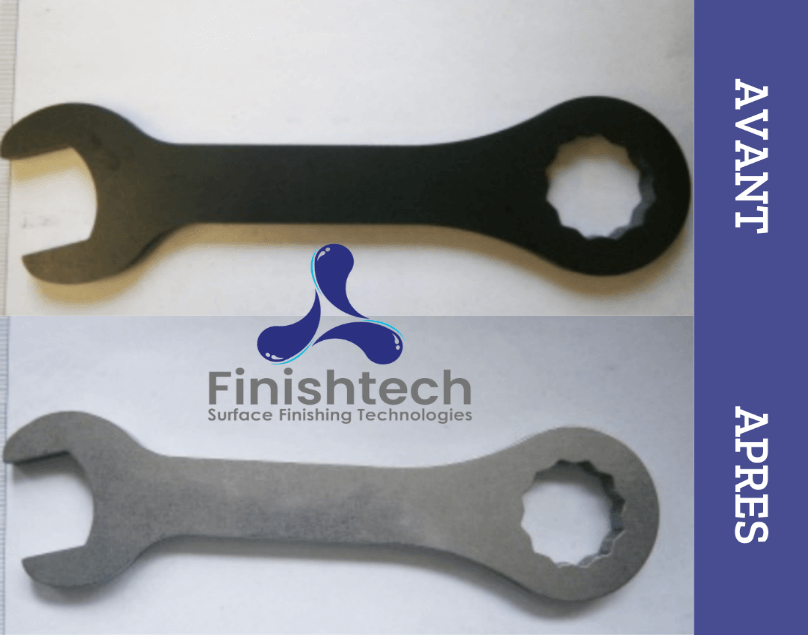
A part before and after mass finishing
The aim of this mass finishing treatment was to prepare these steel adjustable wrenches for plating through deburring and then descaling.
This result was achieved in about 4 hours of processing in our circular vibrator, following 2 steps:
-
- Step 1: deburring and descaling of the adjustable wrenches using a combination of medium-cut ceramic abrasive media and a chemical additive specially designed to remove surface defects from metal parts.
- Step 2: preparing the surface of the adjustable wrenches for plating: processing the parts with suitable ceramic abrasive media and a chemical additive specially designed for polishing.
How many parts can be processed at once in a mass finishing cycle?
The quantity of parts that can be processed in a single mass finishing cycle is determined by the media/part ratio.
This ratio is determined by calculating the volume of the part to be processed and the volume of the processing tub of your mass finishing machine.
The most common ratio is as follows: 1/3 parts to 2/3 abrasive media
This ratio allows perfect mixing of the parts within the media and delivers an optimal finish.
In some cases, particularly with small parts, you can:
Within the limits of the tub capacity, opt for an equal part/media volume ratio.
With fragile parts, you must prevent them from knocking against each other.
To do this, use a machine with a carousel that keeps the parts separated.
Processing tubs divided by separation plates are also very useful, as they help preserve the condition of the most fragile parts.
FINISHTECH offers you a free mass finishing trial
FINISHTECH lets you carry out a free trial to give you the best chances of success afterwards. These trials will give you an idea of:
-
- the right machine for you
-
- the most suitable mass finishing media
-
- the chemical additive you need to achieve the desired finishing results