The essential takeaway: Shot blasting utilizes high-velocity centrifugal turbines rather than compressed air to project abrasives, offering superior efficiency for cleaning and strengthening hard metals. This mechanical power ensures optimal coating adhesion and fatigue resistance, while precise media selection turns raw aggression into a controlled, recyclable engineering process for industrial finishing.
Are coating failures or stubborn contaminants compromising the integrity of your metal components? Mastering shot blasting allows you to aggressively clean and strengthen surfaces using precise centrifugal force rather than compressed air. We examine the specific abrasive media and turbine settings necessary to achieve superior adhesion and fatigue resistance in your workshop.
- What is Shot Blasting and How Does It Work?
- Mastering the Finish: Abrasive Media and Process Control
- Shot Blasting in the Real World: Pros, Cons, and Practicalities
What is Shot Blasting and How Does It Work?
The Core Mechanics: A Centrifugal Force Process
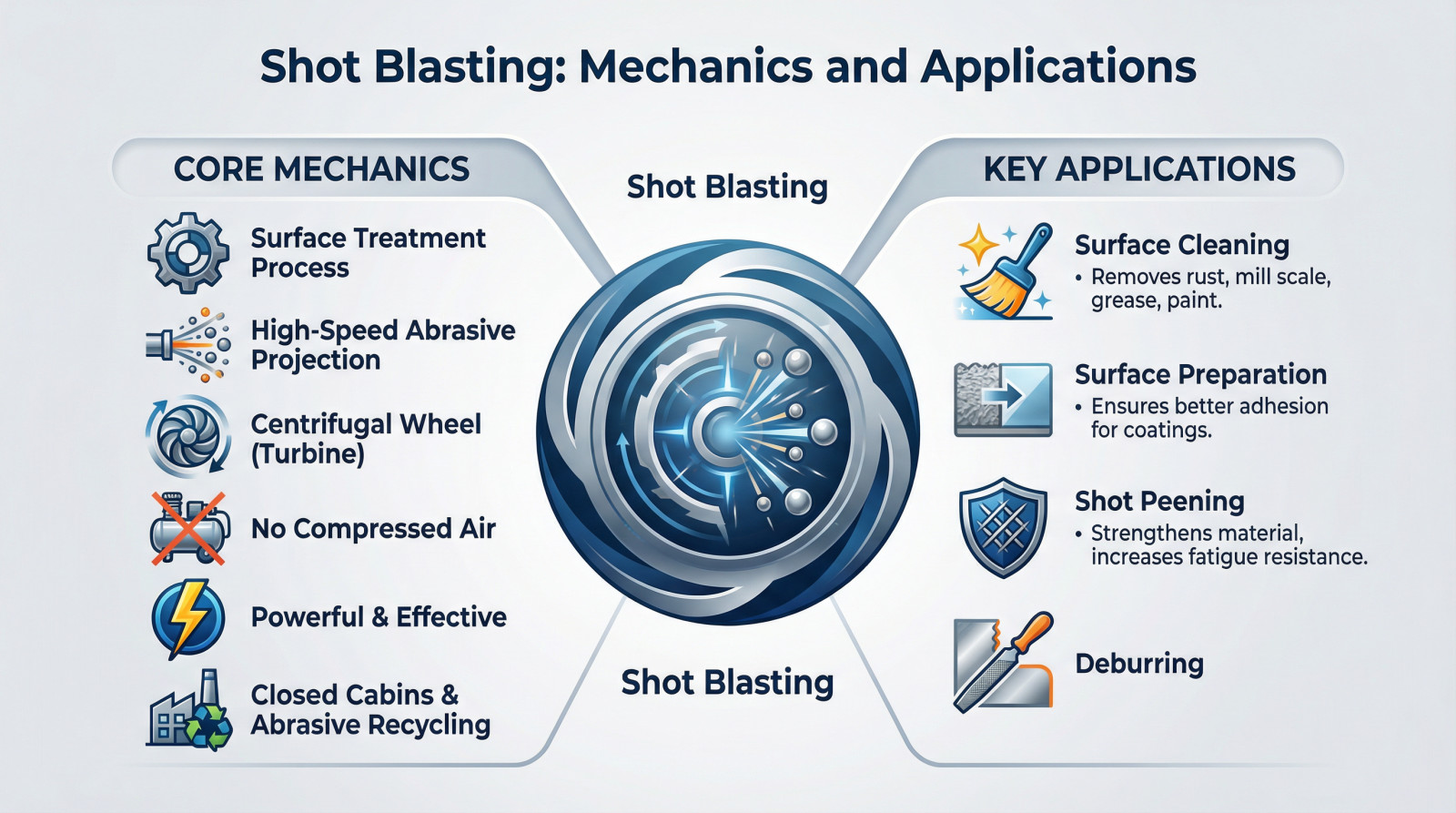
Shot blasting is a high-impact surface treatment method that propels abrasive particles at extreme speeds. The secret isn’t air; it relies on a centrifugal projection wheel, or turbine, to launch the media. This mechanical turbine is the heart of the technology, delivering kinetic energy far beyond standard methods.
You need to stop confusing this with sandblasting. While sandblasting depends on compressed air—making it softer—shot blasting uses raw mechanical force. It is significantly more aggressive, making it the only viable choice for stripping hard surfaces efficiently.
The entire chaotic process happens inside closed cabins to protect the shop floor. Modern setups are smart, automatically recycling the abrasives. This makes the operation cleaner and cuts material costs, offering a massive economic advantage.
From Cleaning to Strengthening: Key Applications
Primary application? Aggressive cleaning. We use it to obliterate rust, mill scale, heavy grease, or old paint layers. It acts as a complete reset button, stripping the component down to the bare, raw metal.
But cleaning is just the start; we are really preparing the substrate. The process etches a specific profile, guaranteeing better adherence for paints or coatings. Without this proper metal surface treatment, finishes fail prematurely, costing you money in the long run.
Then there is the specialized technique of shot peening. Unlike cleaning, this variant hammers the surface to induce compressive stress, drastically strengthening the material against fatigue. It also handles deburring, smoothing out sharp edges instantly.
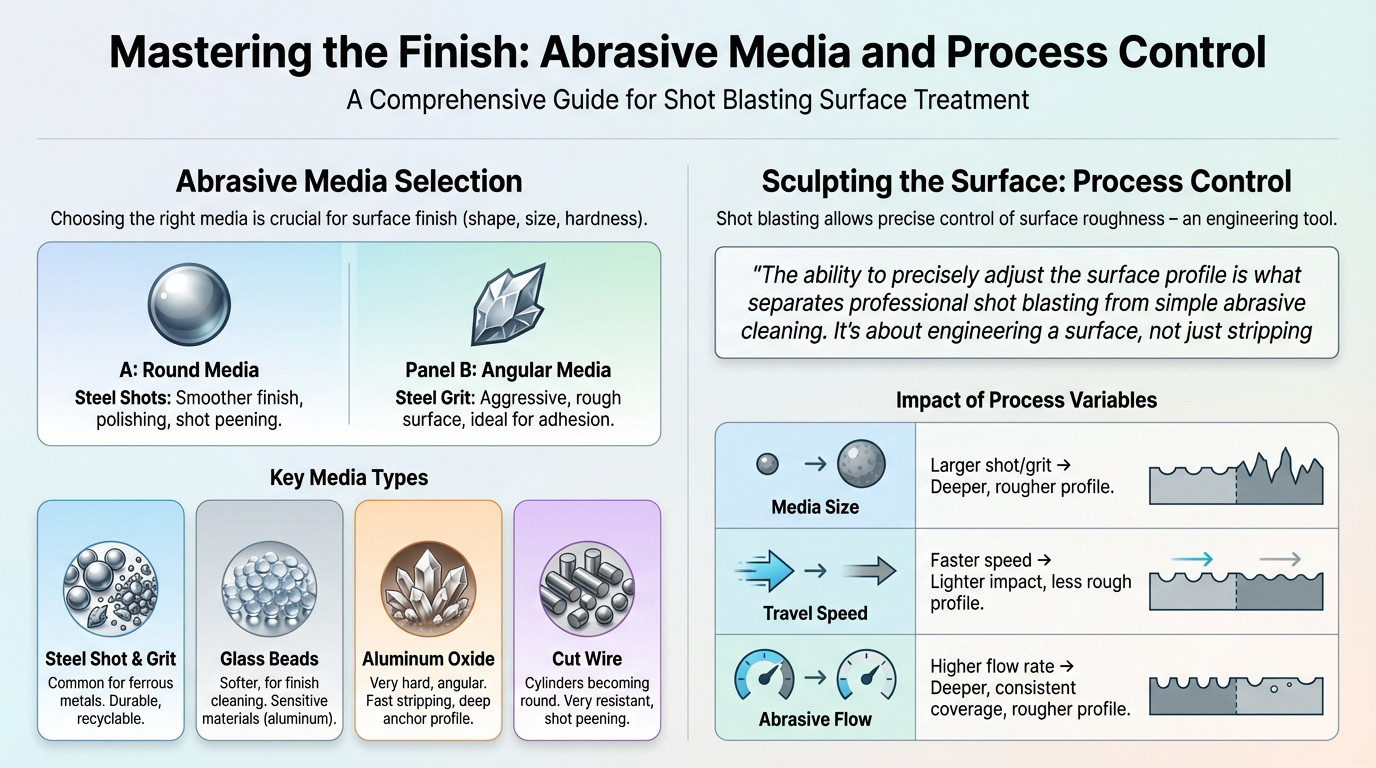
Mastering the Finish: Abrasive Media and Process Control
Shot Blasting in the Real World: Pros, Cons, and Practicalities
The Trade-offs: Shot Blasting vs. Other Surface Treatments
Let’s be real: this method dominates when time is money. Its edge is speed and efficiency, perfect for large surfaces. Plus, the recycling of abrasives eliminates chemical waste, making operations surprisingly green.
But here is the catch. The process is often too aggressive for thin sheets or soft metals, causing warping. Also, the initial equipment cost hits the budget harder than simpler setups.
Ultimately, the project dictates the method. Deciding between Shot blasting or sand blasting simply comes down to the specific finish and control you need.
Choosing between shot blasting and sandblasting isn’t about which is better, but which is right. One offers raw power and efficiency, the other offers control and finesse.
Getting the Job Done: Equipment and Industry Realities
In the workshop, we rely on wheelblasting machines for mass production. However, airblasting cabinets remain the go-to alternative for unique components requiring manual precision.
Not ready to buy? For one-off projects, shot blasting machine rental is a smart move. Portable units for concrete floors are particularly viable options for contractors.
This isn’t just labor; it is a craft. It demands the sharp eye of a qualified operator, maintenance technician, or process engineer to ensure quality.
- Automotive: For engine blocks, gears, and frames.
- Aerospace: For landing gear components and turbine blades (shot peening).
- Construction: For preparing concrete floors and steel structures.
- Foundries: For removing sand and scale from castings.
Mastering shot blasting transforms a standard cleaning step into a precise engineering process. By selecting the optimal abrasive media and controlling impact variables, you guarantee surface durability and coating adhesion. At Finishtech, we support your industrial performance with expert guidance, ensuring your mass finishing operations deliver consistent, high-quality results.