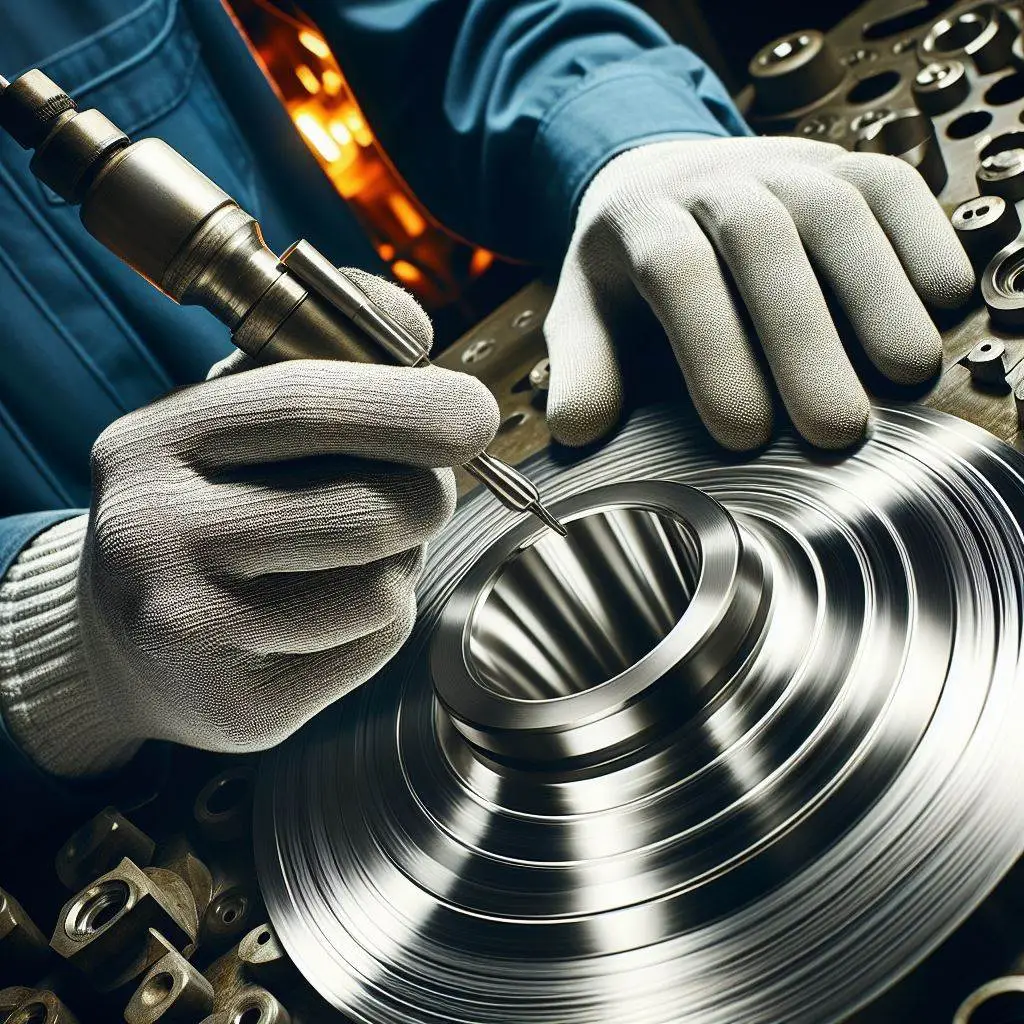
Metal surface treatment is an essential step in many industries. It prepares metal surfaces before the application of coatings or specific treatments. In this article, we will explore in detail the different types of metal surface treatment, their advantages and their applications in various industrial sectors.
What is metal surface treatment?
Metal surface treatment refers to all the processes used to modify the surface properties of a metallic material. These treatments can have several objectives, such as improving appearance, durability, corrosion resistance or electrical conductivity.
At first glance, there are many metal surface treatment processes. Among the most commonly used are mass finishing, polishing, chrome plating, anodizing, zinc plating, phosphating and industrial painting.
Mass finishing
Mass finishing is a surface treatment process that involves setting in motion parts and abrasive media. This process improves surface quality by reducing roughness and irregularities. To optimize efficiency, the cycle time is determined in order to obtain the best results. Moreover, mass finishing is one of the most effective metal surface treatment methods. Thanks to its expertise, Finishtech offers a wide range of mass finishing machines. We work with the British manufacturer Acton Finishing to supply you with the best machines.
Polishing
Polishing, for its part, aims to give a shiny and smooth finish to a metallic material. It is a process of thorough cleaning of the surface using abrasive tools. It removes imperfections, scratches and surface defects, while improving light reflection.
Chrome plating
Chrome plating is a process of coating a metal object with a thin layer of chromium. It can serve both decorative and functional purposes. Chrome plating is generally carried out by electroplating in an electrolytic bath. As a result, it offers excellent protection against corrosion and improves the resistance of the material over time.
Anodizing
Anodizing is a surface treatment commonly used on light metals such as aluminum. It consists of forming a protective oxide layer on the metal surface by electrolysis. Anodizing improves the corrosion resistance of aluminum while offering the possibility of coloring the surface. This treatment is widely used in the automotive, aerospace and other sectors where lightness and strength are important criteria.
Metal surface treatment by zinc plating
Zinc plating is a process of coating with a layer of zinc to protect the metal from corrosion. It can be carried out using different processes, such as hot-dip galvanizing , electrogalvanizing or mechanical galvanizing. It therefore offers excellent protection against galvanic corrosion and extends the service life of metal parts.
Metal surface treatment by phosphating
Phosphating is a chemical treatment commonly used for ferrous metals and alloys. It consists of altering the metal surface with phosphate crystals that bond chemically to the metal substrate. In addition, phosphating improves the corrosion and wear resistance of the material. It is an ideal treatment for parts intended to be painted.
Industrial painting
Industrial painting is a process used in many industrial sectors. It consists of applying a paint coating to the metal surface to improve the appearance, resistance to corrosion and durability of the material. There are also different types of industrial paint, such as liquid paint, powder coating and cataphoresis (e-coating).
The advantages of metal surface treatment
Metal surface treatment offers many advantages in various industrial sectors. Here are some of the main advantages:
- Corrosion protection : first, surface treatments such as zinc plating, anodizing and phosphating offer excellent corrosion protection, which extends the service life of metal parts.
- Improved appearance : next, polishing, chrome plating and industrial painting improve the appearance of metal parts, making them more visually attractive.
- Wear resistance : some surface treatments, such as shot blasting and phosphating, improve the wear resistance of metal parts, which increases their durability and longevity.
- Improved mechanical properties : in addition, some surface treatments improve the mechanical properties of metals, such as tensile strength and hardness.
- Preparation for other treatments : surface treatment also prepares metal parts for other treatments, such as painting, bonding or welding, by improving adhesion and chemical compatibility.
Applications of metal surface treatment
Metal surface treatment is widely used in many industries. Here are some of the most common applications :
- Automotive industry : surface treatment is essential in the automotive industry to protect parts against corrosion and improve their appearance.
- Construction industry : it is used to protect building materials against corrosion and physical damage.
- Electrical industry : here, it is used to improve the electrical conductivity of parts and protect them against corrosion.
- Medical industry : it is used in the manufacture of medical equipment to ensure biocompatibility and corrosion resistance.
- Aerospace industry : metal surface treatment is essential in the aerospace industry to improve the corrosion resistance and durability of aeronautical components.
- Food industry: it is also used to guarantee the hygiene and corrosion resistance of equipment used in the food industry.
These applications represent only a fraction of the many uses of metal surface treatment in different industrial sectors.
Conclusion
Metal surface treatment is an essential step in many industries. It improves appearance, durability, corrosion resistance and the mechanical properties of metal parts. Thanks to a wide range of surface treatment processes, it is possible to meet the specific needs of each industry. Whether for the automotive, construction, electrical or medical industry, metal surface treatment plays a crucial role in manufacturing high-quality, durable products.