Key takeaways: The finishing machine guarantees the aesthetic and functional quality of metal parts, a critical issue in aerospace and medical applications. The choice of machine determines the corrosion resistance, dimensional accuracy and service life of components. Finishtech offers tailor-made solutions, combining French know-how and British technology
Does achieving a perfect finish on your metal parts seem like an insurmountable challenge? Between stubborn roughness, persistent sharp edges and the need for batch processing, surface quality becomes a critical issue in sectors such as aerospace and automotive. Finishing machines, true industrial allies, turn these challenges into concrete solutions: gentle mass finishing, mirror polishing and aggressive deburring will hold no more secrets for you. Discover how these technologies, combining controlled vibration and centrifugal force, guarantee an optimal finish while reducing production times. A turnkey answer for flawless quality!
- What is a finishing machine and why is it crucial?
- Focus on metal finishing: a matter of performance and quality
- The main families of finishing machines for metals
- How to choose the right industrial finishing machine
- Finishtech, your expert partner for a flawless surface finish
What is a finishing machine and why is it crucial?
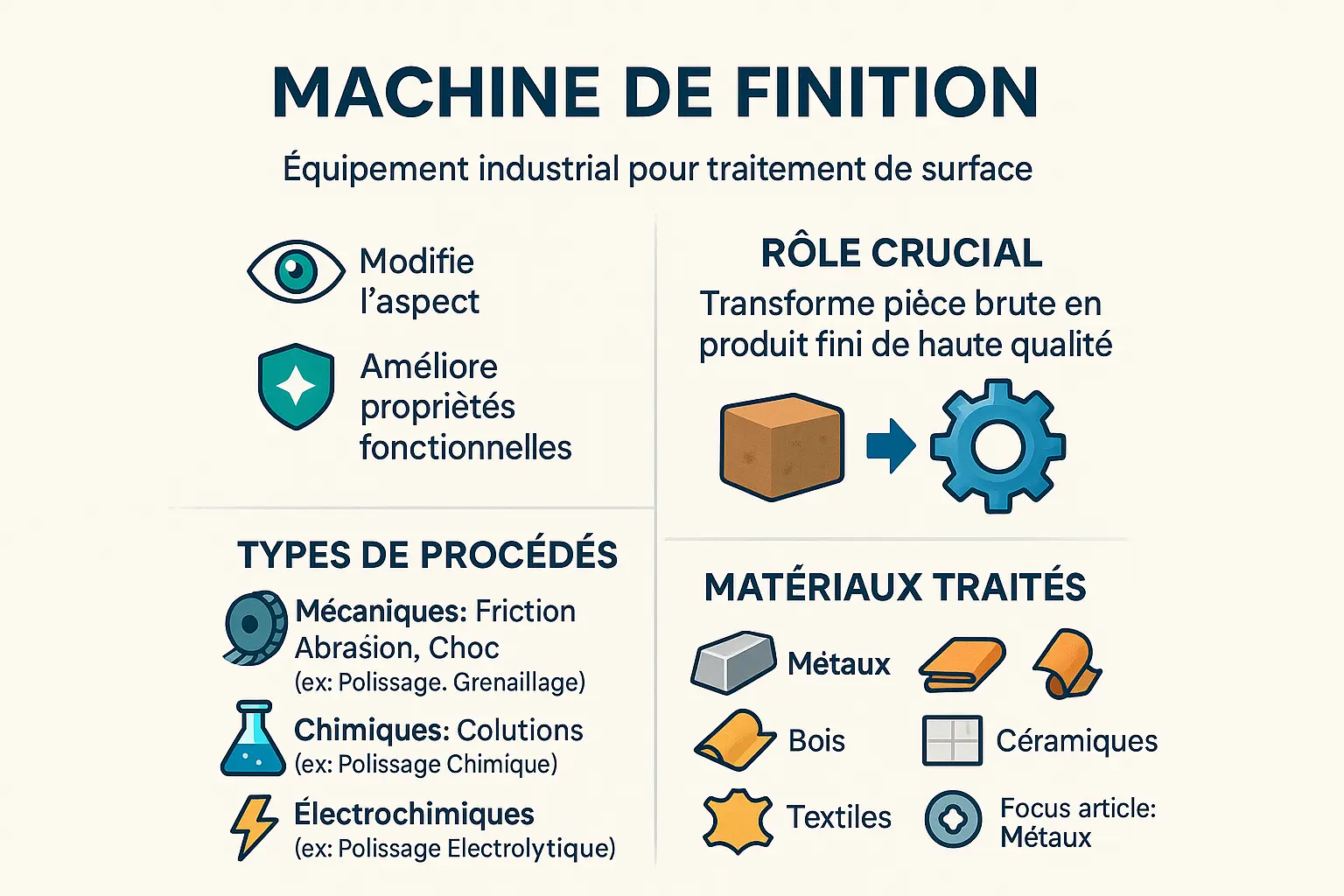
A finishing machine is a piece of industrial equipment designed to modify the surface of a part, improving both its appearance and its functional properties. It makes it possible to achieve optimal quality by controlling roughness, gloss or wear resistance. This decisive step for demanding sectors such as aerospace and medical guarantees a finished product fit for purpose. For example, medical implants require an ultra-smooth surface to prevent bacterial growth.
Mechanical processes include sanding with abrasive belts, shot blasting to harden metals, and mass finishing, FINISHTECH’s specialty. Mass finishing uses vibration and abrasive media (such as ceramic or resin chips) to polish or deburr complex metal parts. These methods ensure a uniform finish on a large scale, ideal for applications such as automotive components or watchmaking.
Chemical techniques, such as chemical polishing, use acid baths to remove irregularities while preserving geometry. Electrochemical methods, such as electropolishing, combine electric current and acid solutions (sulfuric or phosphoric acid) to produce an ultra-smooth surface, ideal for sensitive medical implants. This process relieves mechanical stresses and improves corrosion resistance, a key criterion in the food industry.
These machines process a variety of materials: metals (stainless steel, aluminum), wood, plastics, ceramics, leather or textiles. For metals, requirements vary : aluminum requires a scratch-free finish for aerospace, while stainless steel must be passivated to resist corrosion in the food industry. In the automotive industry, steel parts are shot blasted to increase their endurance.
In France, FINISHTECH offers equipment suited to both small series and large quantities, illustrating the importance of tailor-made technology. The range includes vibratory systems for large volumes and compact models for specific batches. Their mass finishing know-how meets today’s industrial requirements, which determine competitiveness on the market, whether for electronic components or architectural decorative elements.
Focus on metal finishing: a matter of performance and quality
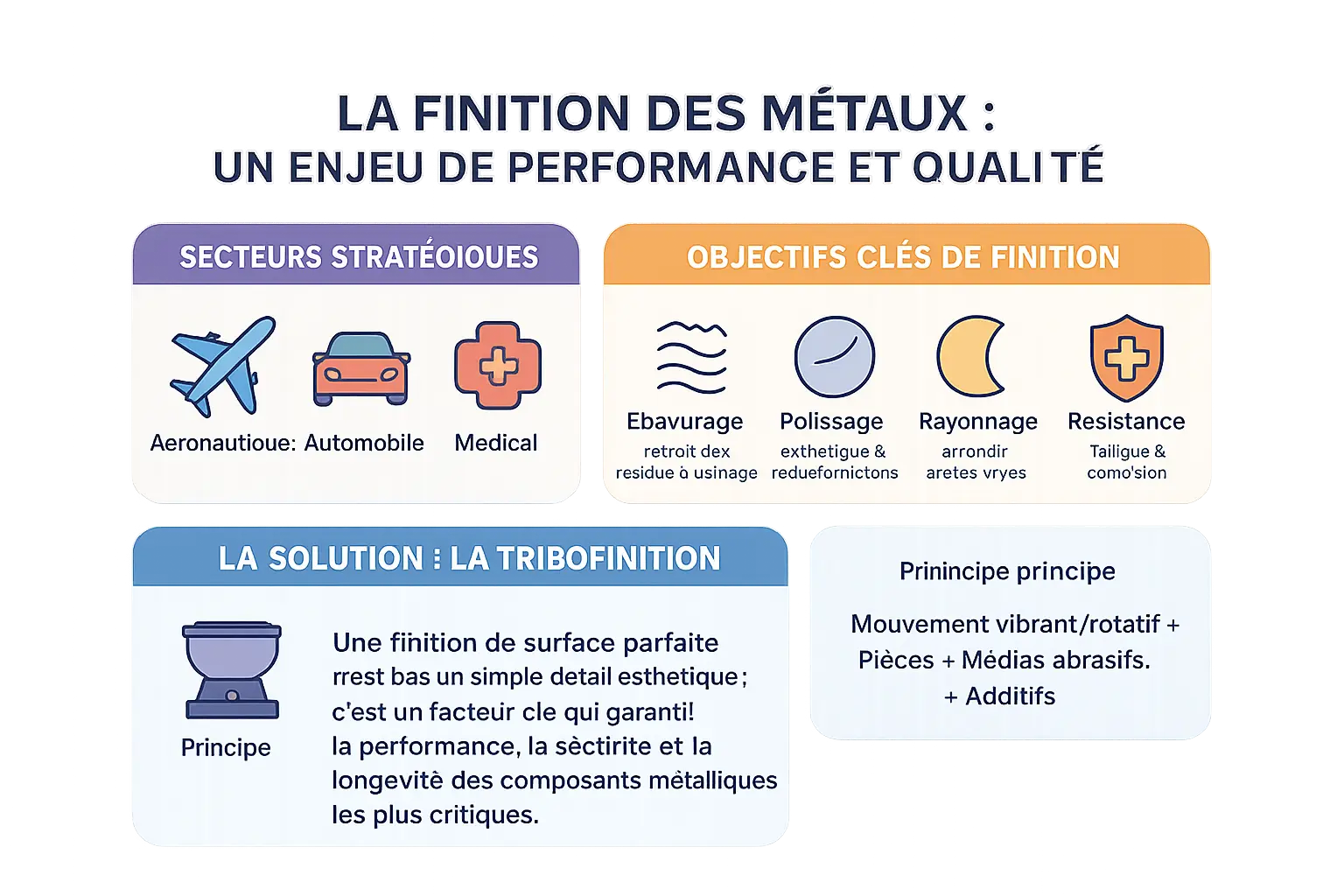
Demanding industries such as aerospace, automotive, watchmaking and medical cannot ignore the finishing of metal parts. A microscopic defect or a poorly treated surface jeopardizes safety, durability and technical performance.
The objectives of finishing metal parts vary according to needs: removing burrs with precise deburring, softening corners through polishing, or rounding off sharp edges by edge radiusing. These steps are not only about appearance: they also improve fatigue resistance (the ability to withstand repeated stresses) and corrosion resistance (protection against oxidation).
To meet these requirements, mass finishing stands out as a versatile solution. This mechano-chemical process combines a vibratory or rotary motion with the action of abrasive media and additives. By reducing friction and evening out the surface, it guarantees a uniform finish even on complex series. Discover how mass finishing works, ideal for batch processing a variety of parts.
A perfect surface finish is not just an aesthetic detail; it is a key factor that guarantees the performance, safety and service life of the most critical metal components.
Whether for aircraft components exposed to extreme temperatures or medical implants in contact with the human body, the precision of the finish determines the reliability of the final product. By integrating technologies such as mass finishing, manufacturers optimize their productivity while meeting the strictest standards.
The main families of finishing machines for metals
Metal finishing technologies are divided into categories suited to specific needs. FINISHTECH offers a complete range that meets industrial challenges, with solutions for the automotive, aerospace and medical sectors.
Mass finishing vibrators
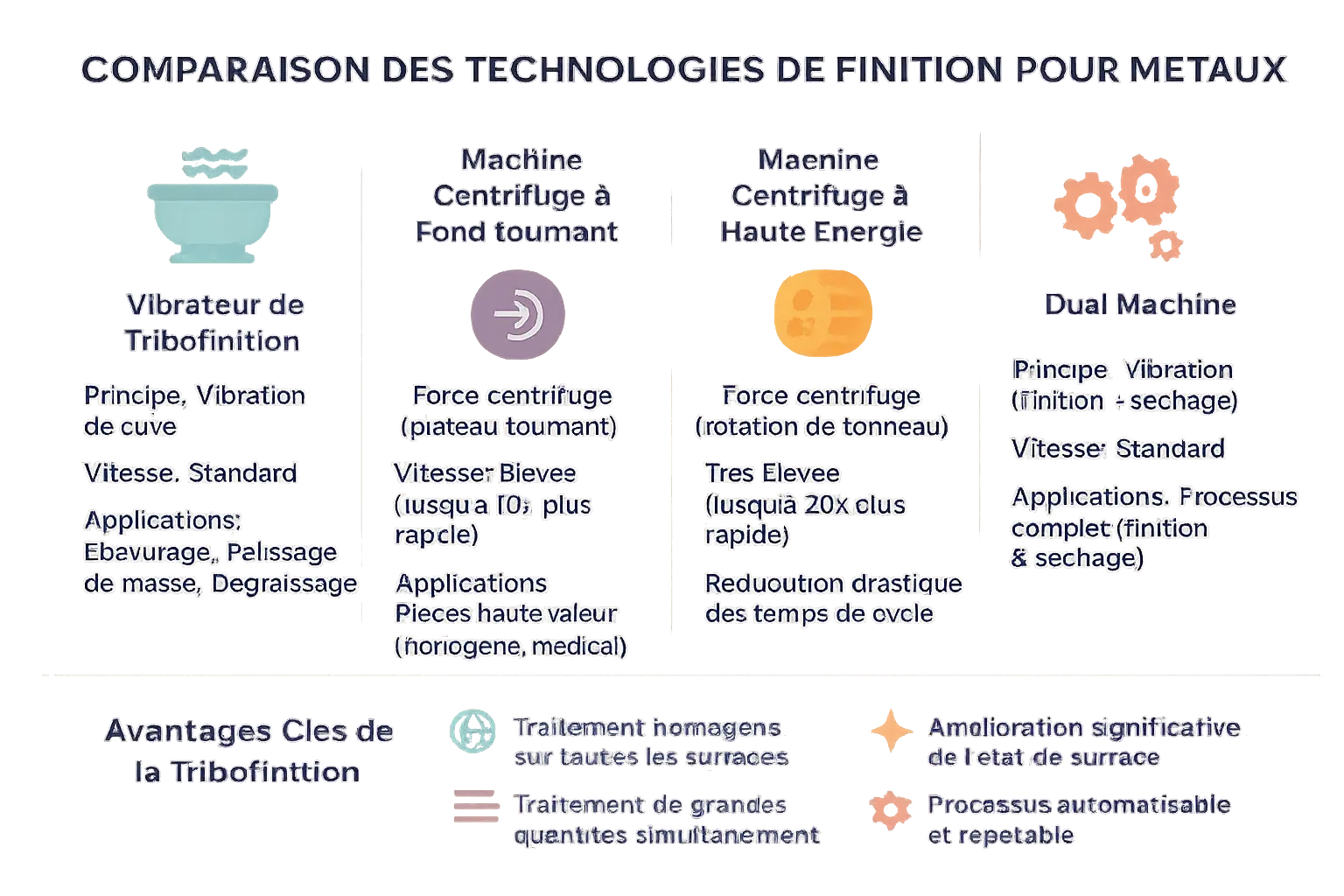
Mass finishing vibrators use vibrating tubs to process metal parts. Their system drives an orbital movement of the media and parts for uniform contact. Ideal for large series, they carry out deburring, edge radiusing and polishing in continuous flow. Available in circular or linear versions, they are suited to simple or moderately complex geometries.
Rotary bottom centrifugal machines
Using centrifugal force via a rotating disc, these machines generate 5 times more energy than conventional vibrators. They allow fast mirror polishing, ideal for precision parts (watchmaking, medical). Their parameter control reduces surface defects while preserving fragile geometries.
High-energy centrifugal machines
High-energy centrifugal machines (centrifugal barrels) reach up to 20 times the power of vibrators. Their robust design allows aggressive deburring on hard metals or complex shapes. They are preferred to reduce cycle times while maintaining quality. Discover their applications on the high-energy centrifugal machines page.
| Technology | Principle | Processing speed | Main applications | Ideal for… |
|---|---|---|---|---|
| Mass finishing vibrator | Vibration of a tub | Standard | Deburring, edge radiusing, mass polishing, degreasing | Large series of simple to moderately complex parts |
| Rotary bottom centrifugal machine | Centrifugal force (rotating disc) | High (up to 10x faster) | Fine polishing, precision deburring | High value-added parts (watchmaking, medical) |
| High-energy centrifugal machine | Centrifugal force (rotating barrels) | Very high (up to 20x faster) | Aggressive deburring, fast mirror polishing | Reducing cycle times |
| Dual Machine | Vibration (finishing + drying) | Standard | Complete process in a single tub | Optimizing space and production flow |
Dual Machine: integrated solutions
The Dual Machine combines mass finishing and drying in a single unit. Its double tub system eliminates intermediate handling. The media are recycled automatically, and the parts move from one compartment to the other via a screening system. Discover its capabilities on the Dual Machine page.
- Uniform treatment across all surfaces.
- Ability to process large quantities simultaneously.
- Significant improvement in surface condition.
- Automatable process for consistent quality.
A critical choice of machine
The choice depends on production volume, part complexity and the desired results. FINISHTECH supports manufacturers in selecting solutions that combine performance and technical suitability, with a complete offer including deburring techniques.
How to choose the right industrial finishing machine
To guarantee optimal finishing quality and efficient productivity, choosing a finishing machine depends on precise technical and economic criteria. Ignoring these parameters could lead to additional costs or unsatisfactory results. Here are the essential selection criteria.
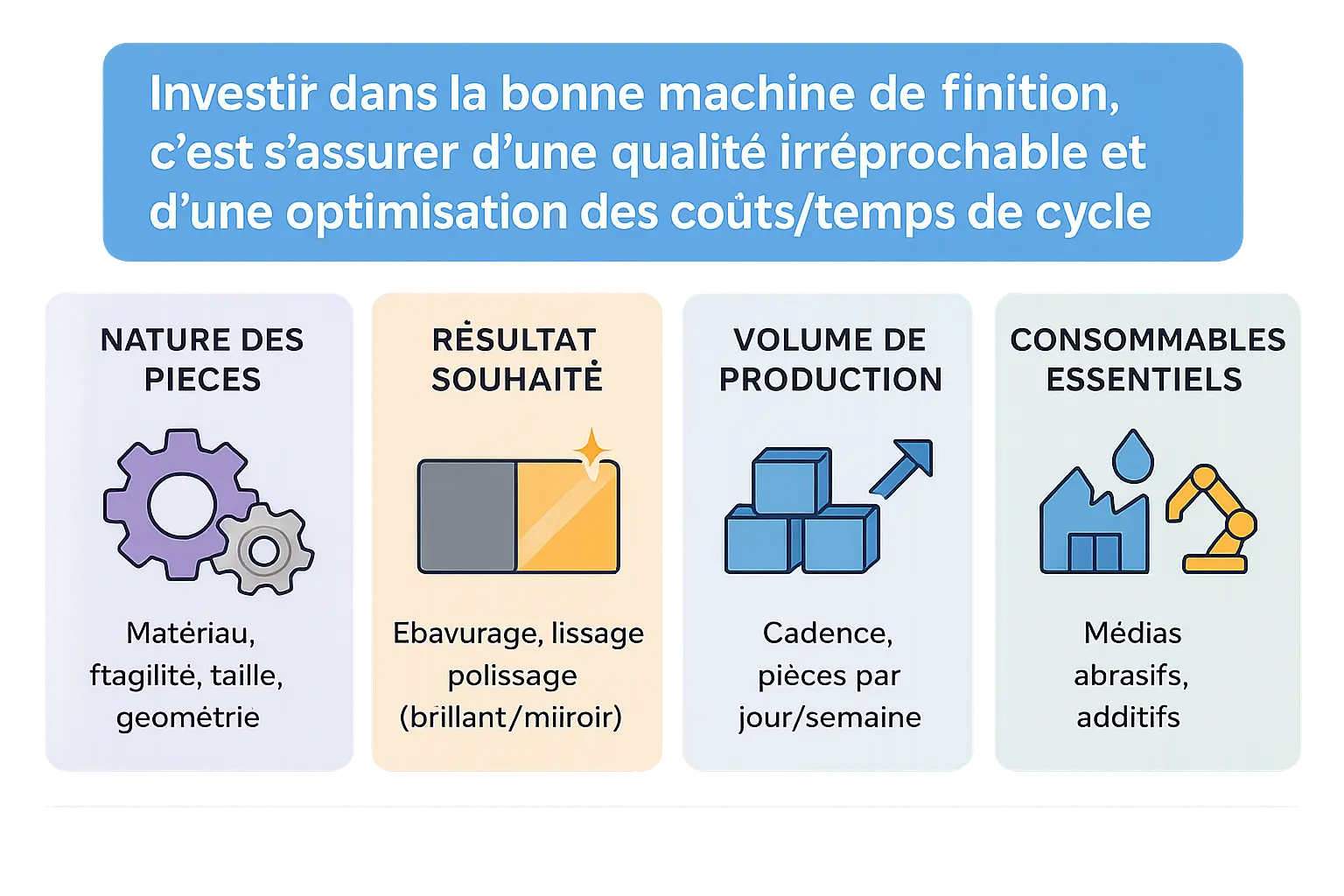
- The nature of the parts : identify the material (steel, stainless steel, aluminum, titanium, brass) and its characteristics (fragility, size, geometry). For example, a machine suited to aluminum may not be suitable for hardened steel.
- The desired finish : determine whether you need simple deburring, surface smoothing, bright polishing or mirror polishing. Some specialized machines, such as centrifugal mass finishing models, are designed for extreme finishes.
- Production volume : assess your hourly or daily throughput. Vibratory or centrifugal machines, ideal for mass processing, should be preferred for high production volumes, while a manual machine will be enough for small series.
- Operational constraints : check the space available in your workshop, energy requirements (electric, pneumatic) and the possibility of automation. A tight budget may point toward compact, versatile models.
- Consumables: the type of abrasive media (ceramic, plastic, synthetic) and additives must match your objectives. For example, ceramic media are suitable for hard metals, while urea media are suited to soft materials.
Investing in the right finishing machine means ensuring not only flawless production quality, but also optimized costs and cycle times over the long term.
To make an informed decision, it is essential to work with a finishing expert such as Finishtech. This partner can run trials on your samples, test different combinations of media and parameters, and validate the relevance of the process before purchase. This pragmatic approach reduces risks and guarantees a fast return on investment.
Finally, for companies unsure which model to adopt, decision-making tools such as this guide to choosing your mass finishing machine, simplify the selection process by matching your specific needs with the available solutions.
Finishtech, your expert partner for a flawless surface finish
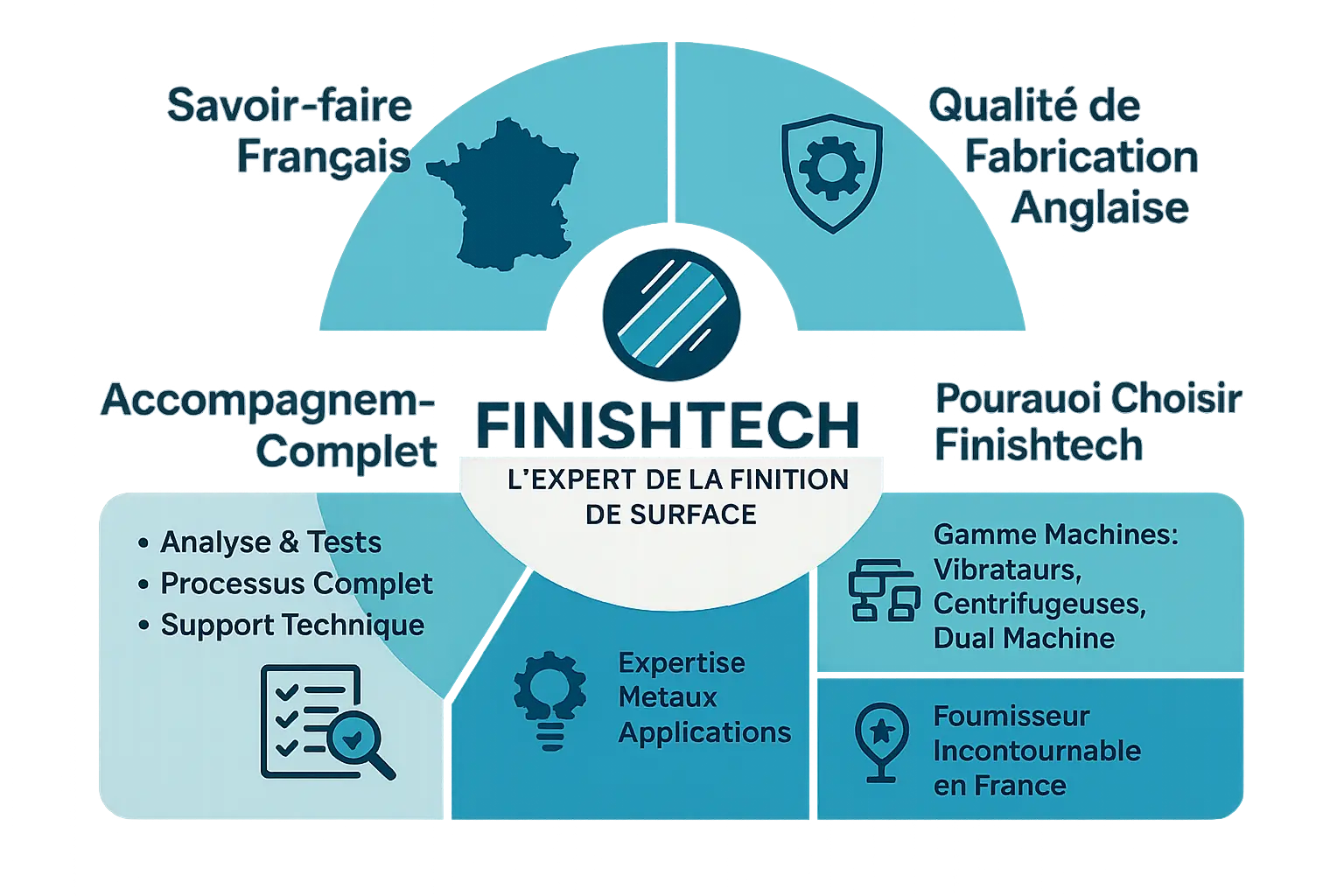
Based in Reims, Finishtech embodies the alliance between proven French know-how and British industrial rigor. A specialist in mass finishing machines, it offers innovative solutions for metal surface treatment, combining cutting-edge technology and tailor-made support.
Finishtech’s strength lies in its partnership with ActOn Finishing, a leading British manufacturer. This collaboration provides a double guarantee : robust equipment designed in England and local expertise to adapt each solution to customers’ specific needs. The Dual Machine, a two-in-one machine (processing + drying), illustrates this synergy, offering compactness and efficiency thanks to its British design and its integration in France.
Finishtech’s support goes well beyond simply supplying equipment. The engineering team is involved at every stage: needs analysis, feasibility tests, choice of abrasive media and process optimization. Training and a premium after-sales service (maintenance, spare parts, assistance) ensure complete support, with a fast response for regulated sectors such as medical.
- Why trust Finishtech with your project :
- A complete range : vibrators, centrifugal machines, Dual Machine, and solutions for small or large volumes
- Expertise covering all metals and applications, from automotive to aerospace
- Personalized support to maximize the return on every investment
- For surface treatment, Finishtech is the go-to partner in France for precision industrial results.
Whether you are looking to improve the appearance or the functional properties of your parts, Finishtech guides you to the ideal solution. Discover now its range of machines and services designed to transform your finishing processes.
See our finishing machines The finishing machine plays a decisive role in the surface finishing of metals, guaranteeing quality, durability and technical performance. From processes such as mass finishing to high-precision centrifugal machines, each technology meets specific needs. At Finishtech, a surface treatment expert, find solutions suited to your industrial challenges. See our finishing machines.