Deburring is an essential step in the manufacture of many industrial parts. It is the process of removing burrs and sharp edges left after machining parts. Deburring is crucial because it improves the quality and safety of finished products.
In this article, we will focus on an advanced deburring method called mass finishing. We will explore the key steps of this innovative process and discuss its advantages over traditional deburring methods.
Introduction to deburring and its importance in manufacturing
Deburring is a finishing operation that consists of removing burrs, sharp edges and surface imperfections from parts. These defects can be caused by processes such as milling, drilling, turning or cutting.
Removing these burrs is essential to guarantee the functionality, safety and appearance of finished products.
Deburring can be carried out in different ways, including traditional methods that can be slow, costly and inefficient. This is where mass finishing comes into play.
💡 Good to know: in French, deburring is called “ébavurage”
What is mass finishing and how does it work?

Mass finishing is an advanced deburring and polishing method that uses abrasive media and vibrations to remove burrs and improve the surface finish of parts.
The mass finishing process works by placing the parts to be deburred in a special tub filled with abrasive media.
The parts and media are then set in motion by vibration or rotation, which allows the media to rub against the parts and remove the burrs.
Mass finishing offers several advantages over traditional deburring methods.
First, it is much faster and more efficient, which increases productivity.
In addition, mass finishing produces a uniform, high-quality surface finish, which improves the functionality and appearance of the parts.
Finally, mass finishing is an automated process, which reduces manual work and labor costs.
Advantages of mass finishing over traditional deburring methods

Mass finishing has many advantages over traditional deburring methods.
First, it removes burrs and sharp edges more efficiently and more quickly. The abrasive media used in mass finishing are specially designed to remove burrs without damaging the parts.
In addition, mass finishing can be used on a wide range of materials, such as metals, plastics and ceramics.
Furthermore, mass finishing produces a uniform, high-quality surface finish. The abrasive media used in mass finishing are available in different sizes and shapes, which makes it possible to adapt the process to the specific needs of the parts to be deburred.
Mass finishing is also used to polish parts and improve their appearance.
Finally, mass finishing is an automated process. This reduces labor costs and increases productivity.
Mass finishing machines are easy to use and can be programmed to deburr a large number of parts in a single operation.
This allows manufacturers to save time and money while improving the quality of their products.
Key steps of the mass finishing process
The mass finishing process comprises several key steps that must be followed to achieve the best results.
- The first step is to choose the appropriate abrasive media according to the material of the parts to be deburred. These can be ceramic balls, plastic cones, stainless steel cylinders or others. It is important to select the media best suited to the parts and the required finishing specifications.
- Second, the selected media are placed with the parts in the mass finishing tub. The tub is then filled with a liquid (water or a special solution) that improves the performance of the process. The mass finishing liquid reduces friction between the media and the parts, making it easier to remove burrs and improving the surface finish.
- Finally, once the parts and abrasive media are in the mass finishing tub, the process can begin. The vibrations or rotations of the tub set the parts and media in motion. Once the process is complete, the parts are removed from the tub, rinsed and then dried.
Understanding the role of abrasive media in mass finishing


Abrasive media play an essential role in the mass finishing process. They are what remove burrs and improve the surface finish of parts. In mass finishing surface treatment, ceramic, plastic or plant-based media are most often used. They are available in different sizes and shapes, which makes it possible to adapt them to the required finishing specifications.
- Ceramic abrasive media are used because they are very hard-wearing and effectively remove burrs from metal parts.
- Plastic abrasive media are used to deburr plastic or rubber parts, as they are gentler.
- Stainless steel media are used to polish parts and improve their appearance.
It is important to choose the most suitable media according to the needs and the required finishing specifications. Note that media that are too hard can damage the parts. Likewise, media that are too soft may not remove burrs effectively.
At FINISHTECH , we provide the best expert advice to help you choose the media best suited to each application.
Choosing the right mass finishing equipment
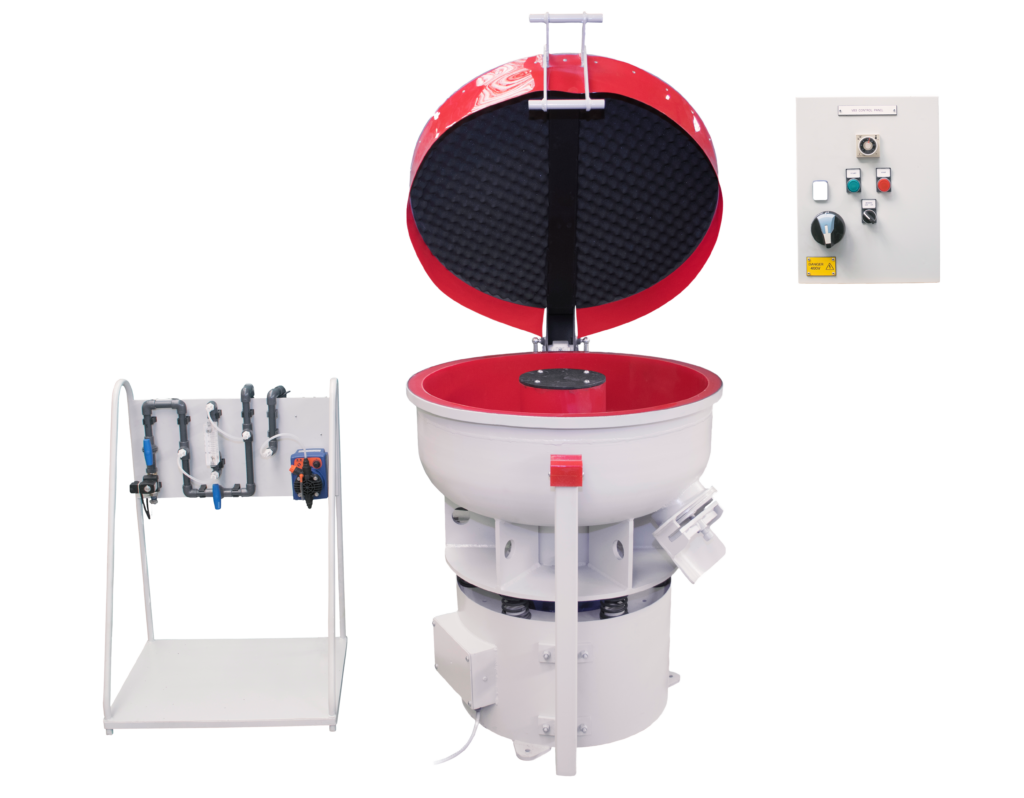


Choosing the right mass finishing equipment is crucial to achieve the best results. There are different types of mass finishing equipment, such as vibratory tub machines, rotary barrel machines and centrifugal machines. Each type of equipment has its advantages and disadvantages, and it is important to choose the one that best suits your specific needs.
- Vibratory tub machines are the most widely used for mass finishing because they are versatile, easy to use and can deburr a wide variety of parts. These machines, ideal for deburring small to medium-sized parts, use different types of abrasive media.
- Rotary barrel machines are used to deburr large or tubular parts. These machines can deburr several parts in a single operation. They are also very efficient for high production volumes.
- Centrifugal machines are used to deburr parts with complex or delicate shapes. They operate with fast rotational movements. Centrifugal machines are ideal for deburring parts that require special care, such as medical parts or electronic components.
Current applications of mass finishing in different industries


Mass finishing is used in many industries to deburr and polish a wide variety of parts.
- In the automotive industry, for example, mass finishing is used to remove burrs from metal parts such as pistons, valves and gears.
- In the medical industry, it is used to deburr implants and surgical instruments, in order to improve their biocompatibility and functionality.
- In the aerospace industry, it is used to deburr aluminum, titanium and stainless steel parts, in order to improve their strength and performance.
- In the electronics industry, mass finishing is used to deburr electronic components, such as printed circuit boards and connectors, in order to improve their reliability and durability.
Many other industries, such as watchmaking, jewelry, optics and the mold industry, also use mass finishing to improve the quality of their products. Mass finishing is a versatile and efficient method that adapts to almost all deburring and polishing applications.
The challenges of deburring and how mass finishing can meet them
Deburring can present many challenges, such as the complexity of the parts to be deburred, materials that are difficult to work with and strict finishing specifications. Traditional deburring methods can be slow, costly and ineffective in meeting these challenges.
This is where mass finishing stands out.
Mass finishing is able to meet the challenges of deburring because it has unique advantages.
First, mass finishing is an automated process that can deburr large quantities of parts in a single operation. This makes it possible to save time and money while guaranteeing consistent quality.
In addition, mass finishing is a gentle method, as it does not damage the parts during the deburring process.
The abrasive media used in mass finishing are specially designed to remove burrs without causing deformation or damage to the parts. This produces high-quality deburred parts with a uniform, flawless surface finish.
Finally, mass finishing offers great flexibility in terms of surface finish. The abrasive media used in mass finishing are available in different sizes and shapes, making it possible to obtain different finishes, from simple burr removal to high-gloss polishing. This allows manufacturers to meet specifications…
Investing in mass finishing
Take advantage of the expertise of Finishtech, which offers a wide range of British-made machines through our partnership with ActOn Finishing. Professionals around the world trust our equipment, because quality and performance are at the heart of our priorities. You can also benefit from the best value for money.
Conclusion: mastering the key mass finishing process
To achieve the best surface finish, it is essential to fully understand and apply all the steps of mass finishing. Although it requires a high level of technical skill, with patience and precision this process makes it possible to achieve remarkable surface qualities. Success lies in meticulously following each successive phase, from initial preparation to final inspection. Beyond the technical dimension, the irreplaceable know-how of the technician deserves to be highlighted, as their expertise gives each part a unique character. The future of this discipline undoubtedly lies in passing on time-honored skills combined with technological advances. In this way, mass finishing will continue to embody the subtle alliance of tradition and modernity in the service of excellence.