

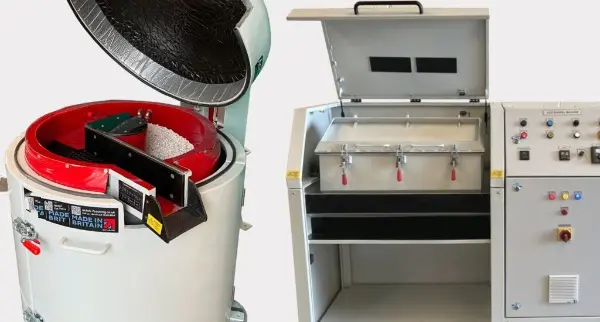
The circular vibrator and the linear vibrator are the best-known mass finishing machines.
Mass finishing is a surface treatment process that makes it possible to treat large quantities of parts in a single cycle while remaining economical and cost-effective.
Both machines can be used on all kinds of parts for the following applications: deburring, edge radiusing, descaling, polishing and cleaning parts at the end of the process.
In this article, we will explain in detail everything you need to know about these two types of mass finishing vibrators through their similarities and differences, and the advantages and disadvantages of each machine, so that you have a clear idea of which machine will best meet your needs.
Mass finishing with the linear vibrator:
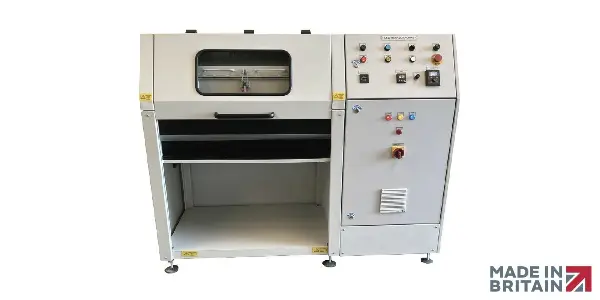
Mass finishing parts with a linear vibrator makes it possible to treat different types of parts at once, known as batches of parts.
As its name suggests, it is a linear machine, in other words with a rectangular tub.
As mentioned above, linear vibrators perform the same functions as their cousins, circular vibrators: deburring, polishing, descaling, edge radiusing and cleaning parts. In addition to all these applications, linear vibrators can also remove traces of rust from metal parts using a special mixture of chemical additive, water and abrasive media.
How does it work in practice?
During the mass finishing cycle, once the linear vibrator is running, the motion of the machine creates vibrations that set the contents of the processing tub in motion, namely the abrasive media, the water/chemical additive mixture and of course the parts to be treated. This vibratory motion causes friction between the media and the parts, resulting in more or less pronounced abrasion of the part surfaces.
Mass finishing with the circular vibrator:
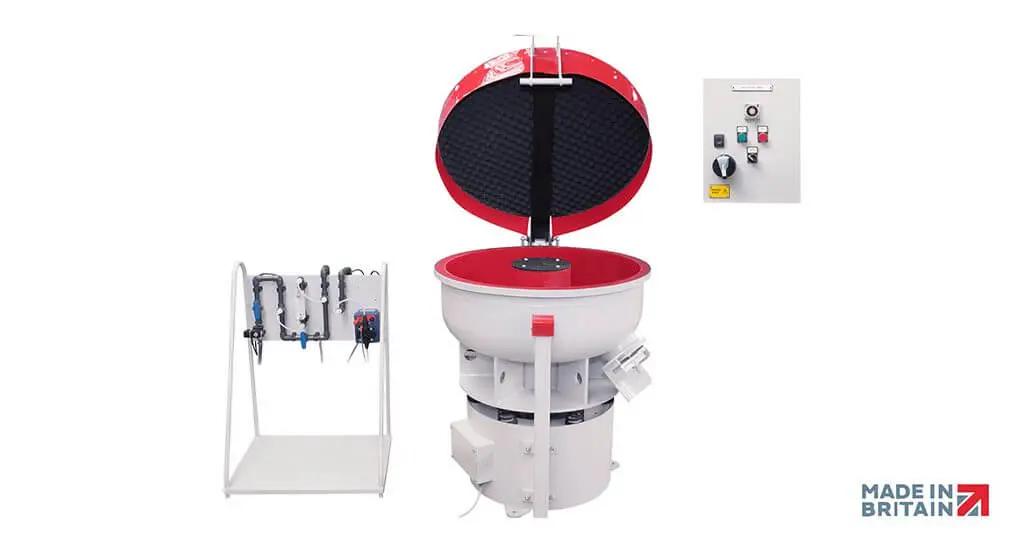
As with the linear vibrator, mass finishing parts with a circular vibrator makes it possible to treat different types of parts at once, known as batches of parts.
This time, it is a circular machine, in other words with a round tub.
As seen above, circular vibrators perform the same functions as their cousins, linear vibrators: deburring, polishing, descaling, edge radiusing and cleaning parts. Using a circular vibrator will allow you to automate your manufacturing process.
How does it work in practice?
During the processing cycle, when the vibrator is running, it generates a helical motion that causes friction between the abrasive media and the parts, producing the desired finish.
The circular vibrator can be used in two modes: a continuous processing system or a batch processing system.
Parts processed in batches must be loaded manually into the processing tub by an operator; they are then processed and must also be unloaded manually by an operator once finished.
On the other hand, parts processed in a continuous system require little or no operator intervention. This system automates the entire process: the parts are loaded at one end of the machine, continue their treatment and are then moved automatically to the other end of the machine to be discharged in their finished state.
The differences between circular vibrators and linear vibrators:
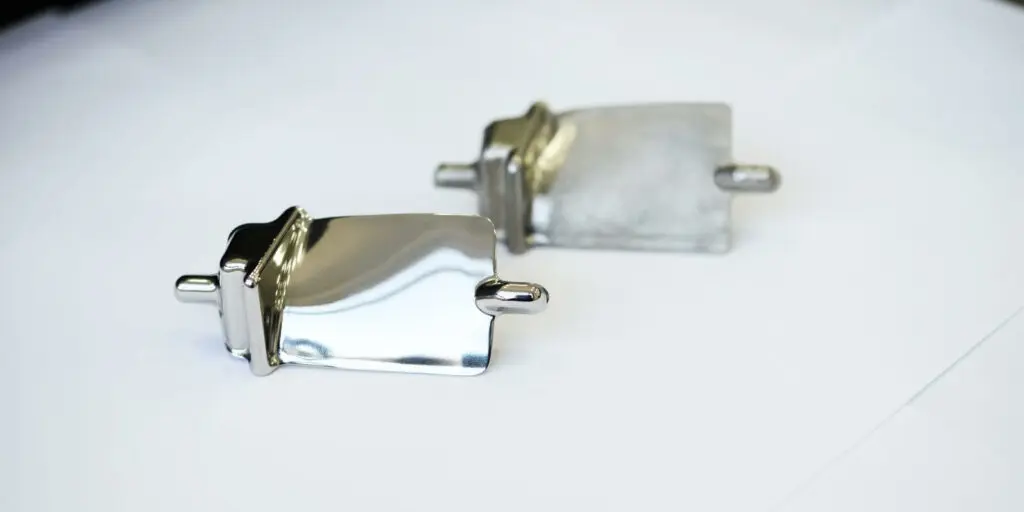
Although both mass finishing machines can carry out a wide range of applications, they are by no means identical in every respect.
While quite similar in many aspects, each vibrator has its own particular features.
The first difference is that circular vibrators can be automated, whereas linear vibrators do not allow this processing mode.
Circular vibrators process parts in shorter times than linear vibrators.
For these reasons, circular vibrators are the machines most purchased by the majority of our customers, as they offer an unbeatable cost/time ratio and unmatched efficiency.
Moreover, the circular vibrator is a much more complex machine than the linear vibrator in terms of its features and operating mode.
Given these significant particularities, it is logical that circular vibrators cost more than linear vibrators.
Another difference not to be overlooked is that processing parts in a circular vibrator gives better results in terms of surface finish (smoother part surfaces, while taking care not to cause excessive wear of the part surfaces). This increases the service life of the parts over time.
Conversely, processing parts in a linear vibrator causes the parts to tumble against each other, which can unfortunately lead to greater surface irregularities.
Let us look in more detail at other features specific to each type of vibrator:
Advantages of using a circular vibrator:
- Possibility of 100% automation of the mass finishing machine: profitability & speed ++
- Faster processing cycle compared with a linear vibrator
- Smooth surface finish of parts without imperfections
- Two processing systems: continuous or batch
- Possibility of processing parts one by one
- Can process different types of parts (from hard metals to polymers)
- Quiet machine in operation
Disadvantages of using a circular vibrator:
- Abrasive media wear faster in circular vibrators
- Somewhat complex processing method
- Costly machine
Advantages of using a linear vibrator:
- Suitable vibrator for processing large parts (long parts, parts with a particular or irregular shape)
- Affordable machine price
- Abrasive media wear more slowly compared with circular vibrators
- The linear vibrator is particularly suited to small batches of parts
- Processing parts in this machine produces rounded finishing results at the ends of the parts
- This is the machine to have if you want to finish parts made of hard materials that require a more aggressive action to remove surface defects, or for foundry parts
Disadvantages of using a linear vibrator:
- Does not allow process automation
- Requires more time to complete a parts processing cycle (compared with the circular vibrator)
- Increased risk of surface irregularities because the parts come into frequent contact with each other during the process
A final word, our advice:
In general, we recommend that our customers invest in a circular vibrator for two reasons:
First, it will allow you to carry out all kinds of mass finishing applications.
Second, it can process parts in very short times while preserving them (gentle action on the parts).
However, this is only general advice based on our experience so far. To make the right choice, we always recommend that our customers run trials on their parts to find out which machine is best suited, depending on the initial condition of the parts, their specific features and the desired surface finish.
There is no denying that each vibrator has its advantages and disadvantages, which is why it is essential to carry out one or more trials to determine with certainty the mass finishing machine best suited to your needs.
Do not hesitate to contact us if you would like more details or support in purchasing your vibrator.