The price of a mass finishing machine ranges between €8,000 and €40,000 for standard models, depending on the technology and tub capacity. Allow from €6,000 for a used machine. For a complete automated line or a high-capacity installation, the budget can reach €150,000 to €300,000.
The reason for this gap is simple: an entry-level circular vibrator and an automated line integrated into a production line do not meet the same volumes or the same requirements. The table below details prices by machine family.
Mass finishing machine prices by type
| Machine | Price range | Suitable for |
|---|---|---|
| Circular vibrator | €8,000 to €21,000 | Standard deburring and polishing |
| Linear vibrator | €8,600 to €25,000 | Large parts |
| Rotary bottom centrifugal machine | €14,000 to €20,000 | Small and medium batches |
| High-energy centrifugal machine | €20,000 to €40,000 | Superfinishing, burnishing, mirror polishing |
| AWP rim machine | €8,500 to €19,000 | Car and motorcycle rim polishing |
| Used machine | from €6,000 | First equipment, controlled budget |
| Complete automated line | €150,000 to €300,000 | Large series, integration into production |
These amounts are for the machines alone, excluding consumables. They are a budget guide, not a contractual price: the final price depends on the exact model and the chosen configuration.
Automated lines and custom installations
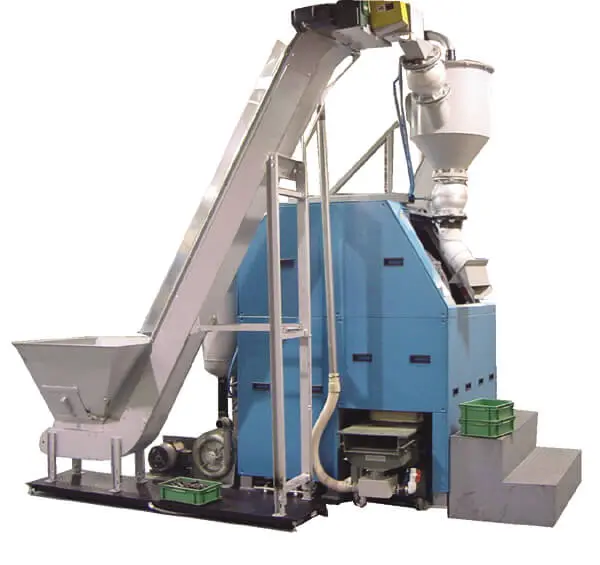
Beyond catalog machines, some projects fall under complete industrial installations. The budget then moves to another scale, generally from €150,000 to €300,000, or even more depending on complexity.
What moves a project into this category:
- Integrating finishing directly into the production line, with automated loading and unloading.
- Very high-capacity machines, beyond standard volumes.
- Coupling several machines in sequence, for example processing, then drying, then sorting.
- Automatic dosing of abrasive media and additives, with monitoring and traceability.
- An integrated effluent treatment solution.
These configurations are quoted to measure, based on your throughput, your parts and your layout. Our automation solutions are designed on a case-by-case basis.
What affects the price
- Tub capacity. This is the first factor, from working volumes of 10 L on the smallest centrifugal machines to more than 1,400 L on large linear vibrators.
- Motor power. From 0.95 kW on compact models to 11 kW on the heaviest machines.
- Technology. For comparable capacity, a centrifugal machine costs more than a vibrator, but processes much faster.
- Level of automation. Automatic separation of parts and media, integrated dosing, automated loading.
- Accessories. Screens, decks, dosing systems, collection tanks.
- Condition. New or used, with a difference that can exceed 30% on comparable models.
Price of a rim polishing machine
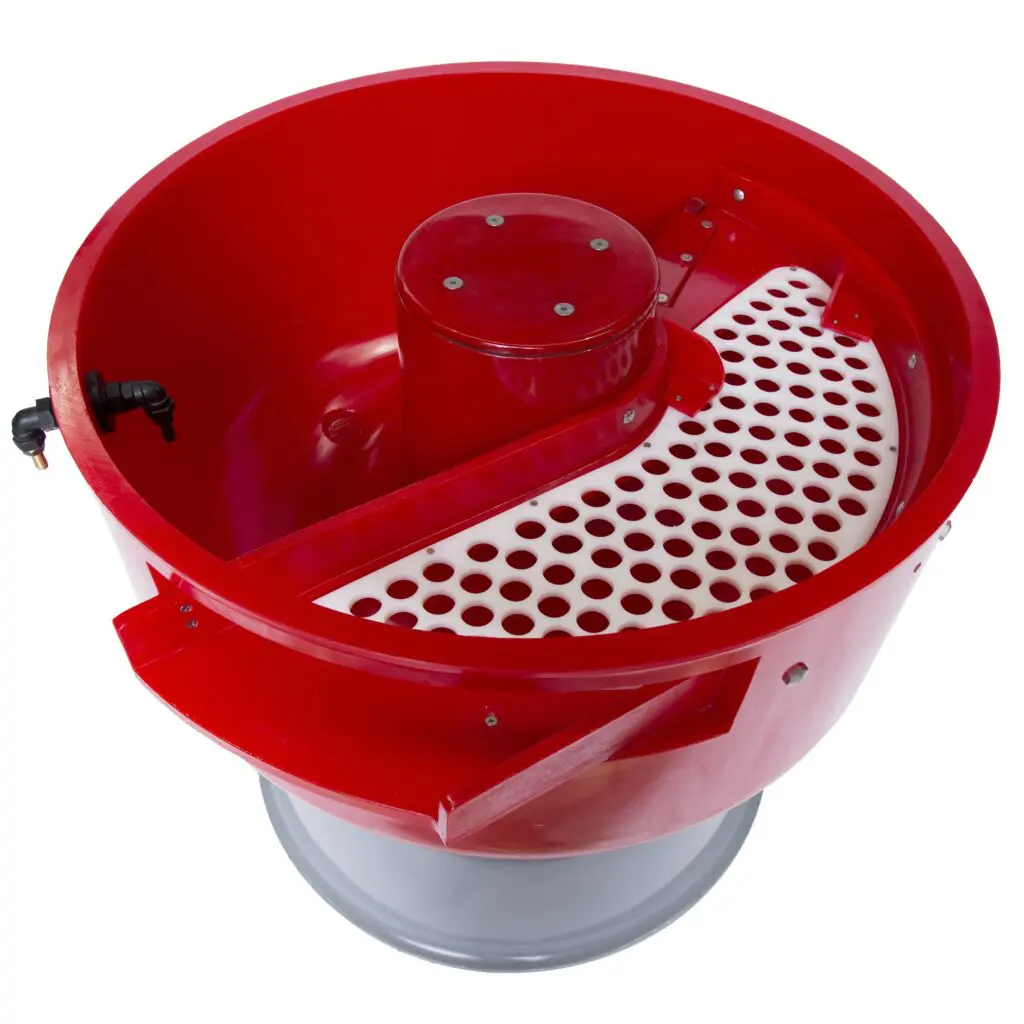
Rim polishing is a separate application, with its own dedicated machine. The AWP twin-motor or triple-motor machine costs between €8,500 and €19,000 depending on the configuration, for a working volume of 188 L and a motor power of 1.2 kW.
Machine or subcontracting: how to decide
Many professionals compare the unit price of polishing an alloy rim with the purchase of a machine. The reasoning to follow is the break-even point: beyond a certain volume of rims processed per year, the investment becomes more economical than subcontracting, while making you independent in terms of lead times.
The calculation depends on your volume, your current price and the level of finish you are aiming for. We can work it out with you based on your actual figures. To understand the process applied to rims, see our page dedicated to rim mass finishing.
New or used machine
A used machine allows you to start with a reduced budget, from €6,000. It is a relevant option for a first piece of equipment, to absorb a production peak or to test a process before investing in new equipment.
Points to check before buying: the condition of the tub and its lining, wear of the counterweights, availability of spare parts and the existence of a warranty. Discover our range of used mass finishing machines.
Technical specifications by machine
Finishtech offers a complete range of mass finishing machines covering a wide range of applications. Each family comes in several models depending on tub volume and the dimensions required. In addition to serving Paris, we deliver throughout France.
Circular vibrators
The circular vibrator removes burrs and surface irregularities that are detrimental to both the appearance and the proper functioning of parts. Eight series are available:
- S series circular vibrator
- B series circular vibrator
- TVB series circular vibrator
- VB1 series circular vibrator
- VBD series circular vibrator
- P series circular vibrator
- O series circular vibrator
- I series circular vibrator
Specifications: working volume from 85 L to 850 L depending on the model, with a motor power of 1.2 kW to 7.5 kW.
Linear vibrators
Available in many sizes and a wide choice of length and width combinations, the linear vibrator is one of our most versatile machines. It is the right solution for large parts. Two models are available:
Specifications: working volume from 85 L to 1,417 L depending on the model, with a motor power of 0.95 kW to 11 kW.
Rotary bottom centrifugal machine
Designed for processing small and medium batches of parts no larger than 150 mm, this machine offers a very short processing time, up to 10 times faster than a circular or linear vibrator.
Specifications: working volume from 38 L to 174 L depending on the model, with a motor power of 5.5 kW to 7.5 kW.
High-energy centrifugal machine
Even more powerful than rotary bottom centrifugal machines, high-energy machines are among the highest-performing on the market. The gravitational force they generate maximizes output and allows all kinds of applications to be carried out meticulously.
Specifications: working volume from 10 L to 240 L depending on the model, with a motor power of 1.1 kW to 11 kW.
Dual machine
Compact, economical and practical, the dual machine is a 2-in-1 solution that carries out mass finishing and drying of parts simultaneously in one and the same machine.
Specifications: working volume from 85 + 85 L to 142 + 142 L depending on the model, with a motor power of 2.2 kW.
Rim polishing machine
Designed for mass finishing car and motorcycle rims, through polishing and grinding applications.
Specifications: working volume of 188 L with a motor power of 1.2 kW.
The budget to plan beyond the machine
A common mistake is to budget only for the equipment. Operating costs are based on three additional items.
- Abrasive media. Ceramic, plastic or plant-based depending on your materials and the level of finish. They wear and are renewed regularly. See our range of consumables.
- Additives. They determine the cleanliness of the bath and the shine obtained. An unsuitable additive degrades the result whatever the machine.
- Effluent treatment. Depending on your volume and local regulations, a water treatment solution may be necessary.
Conversely, mass finishing greatly reduces the unit cost per part by eliminating manual rework and allowing work to be carried out unattended. It is this recurring gain that should be weighed against the initial investment.
How mass finishing works
Mass finishing is an industrial mechano-chemical polishing process that allows the surface treatment of a wide variety of parts, more particularly metal surface treatment, but also steel, ceramics, plastic or aluminum.
The four processing modes
- Continuous system: parts enter at one end of the machine, are processed, then are discharged at the other end continuously.
- Part by part: each part is processed individually, a mode suited to large dimensions.
- In batches: parts are loaded into the tub in batches, processed, then removed before the next batch is loaded.
- Sequential system: a combination of different mass finishing processes.
Possible applications
Deburring, polishing, smoothing, pre-plating finishing, edge radiusing, descaling, barrel finishing, superfinishing, ball burnishing and parts cleaning.
The four conditions for success
For a mass finishing treatment to give the best result, four elements must come together: the right machine, an abrasive media suited to the nature of the parts, an appropriate chemical additive and good-quality water. The final result varies according to the chosen machine, the nature of the media, the choice of additive and the total duration of the process.
To understand in detail how the process works, read our article what is mass finishing.
Frequently asked questions about mass finishing prices
How much does a mass finishing machine cost?
Allow between €8,000 and €40,000 for a new standard machine, depending on the technology and tub capacity. A circular vibrator starts at around €8,000, while a high-energy centrifugal machine can reach €40,000. Used models start at €6,000. A complete automated line costs between €150,000 and €300,000.
What is the cheapest mass finishing machine?
The entry-level circular vibrator, from €8,000, remains the most affordable new option. It already covers most deburring and polishing needs. Below this budget, a used machine is the most realistic alternative.
How much does a rim polishing machine cost?
The AWP machine dedicated to rim polishing costs between €8,500 and €19,000 depending on the configuration. The choice between buying a machine and subcontracting depends on the volume of rims processed each year.
Does the price include abrasive media and additives?
No. The ranges shown are for the machine alone. Abrasive media, additives and any accessories are quoted separately, as they depend on your materials and the level of finish required.
Free trial on your parts before any commitment.