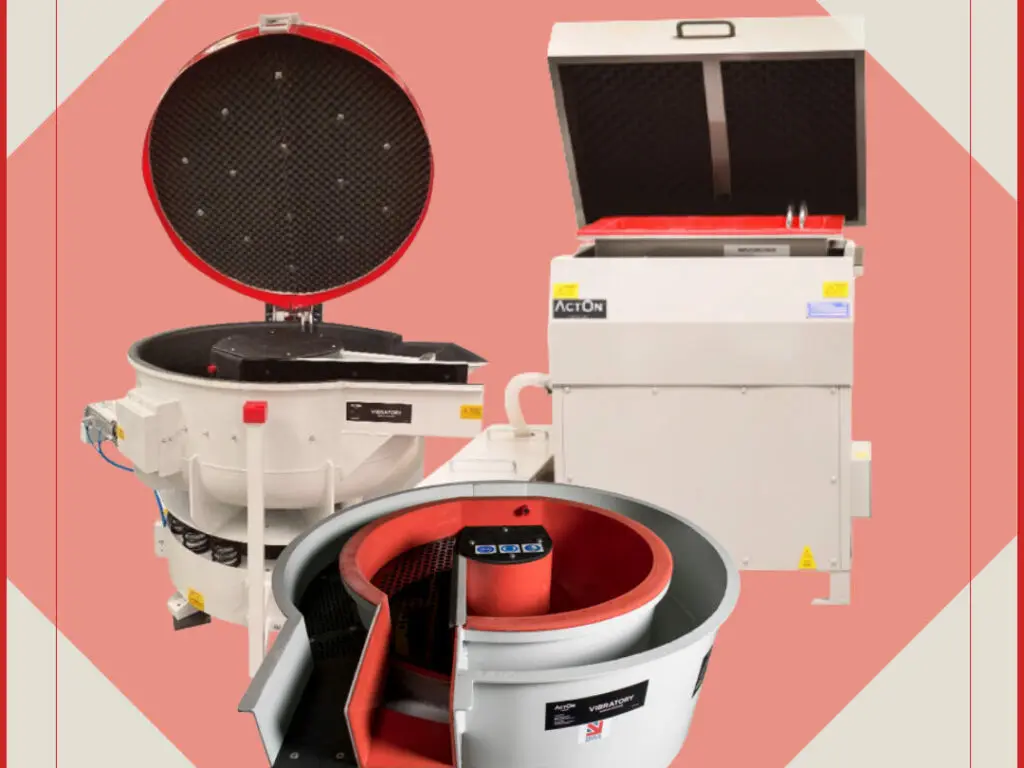
Mass finishing is an advanced surface treatmenttechnique, involving the rotary and vibratory movement of parts in contact with abrasives. Thanks to its versatility, it is widely adopted in critical industries such as aerospace, automotive, mechanical engineering or the medicalsector. At the heart of this process are mass finishing vibrators, machines designed to generate the movement required to process parts effectively.
This method is ideal for various finishes, including deburring, polishing, cleaning or improving the surface quality of metal or ceramic materials. Depending on their specific features (shape, size, weight, nature of the parts), different models are recommended: circular vibrators and linear vibrators for most applications, with variants such as centrifugal vibrators, continuous vibrators or those dedicated to mechano-chemical polishing for specific needs.
This article aims to guide you through the main characteristics, advantages and disadvantages of each type of vibrator. We will also provide practical advice on optimizing and maintaining your mass finishing equipment. You will then be able to choose the tool best suited to your technical and financial requirements.
The evolution of mass finishing vibrators
Mass finishing vibrators are essential equipment that apply mechanical vibrations for the surface treatment of bulk parts. Although their use dates back several decades, their development has benefited from considerable progress.
Let’s take a closer look at how mechanical design, the integration of digital technology, the improvement of finishing quality and innovations have shaped the evolution of these machines.
From mechanical design to digital technology
Initially, mass finishing vibrators were based on a basic mechanical design: a motor drove a vibratory bowl, mounted on springs, in which the parts to be treated were mixed with abrasive materials. This combined rotary and vibratory movement removed excess material from the parts, depending on the need (deburring, polishing, cleaning, etc.).
The advent of digital technology was a turning point, making mass finishing vibrators more efficient, precise, and flexible. Thanks to electronic control systems, it is now possible to precisely adjust variables such as frequency, amplitude or processing time. The automation of loading, rinsing, separation and drying processes has made it easier to integrate them into automated production lines.
In addition, the integration of monitoring and diagnostic systems has strengthened the reliability and safety of this equipment.
How advances have transformed finishing quality
Technological developments have enabled mass finishing vibrators to offer ever more refined finishing quality , meeting the demanding standards of various industrial sectors. These machines are now able to process a wider range of parts, with a great variety of shapes, sizes, weights and materials.
They guarantee finer, more uniform, brighter and more durable finishes while optimizing costs, reducing processing times, energy consumption and noise.
Main innovations in the field of mass finishing vibrators
The sector has seen several major innovations emerge, including:
- Centrifugal vibrators, which use centrifugal force to increase the intensity and quality of the finish.
- Continuous vibrators, allowing smooth processing of parts, without pauses or manual handling, thus improving productivity and profitability.
- Mechano-chemical polishing vibrators, which combine the effect of abrasives with a chemical action to achieve extremely smooth and shiny finishes.
This innovation momentum allows mass finishing vibrators to adapt to the specific needs of certain sectors such as aerospace, medical, jewelry or watchmaking.
Comparison of mass finishing vibrator technologies
Mass finishing vibrators are equipment that use vibrations to process bulk parts. There are two main types: circular vibrators and linear vibrators. Each type offers unique characteristics, distinct advantages and dedicated applications.
This comparative guide to circular and linear vibrators is designed to steer you toward the technology best suited to your finishing requirements.
Circular vs. linear vibrators
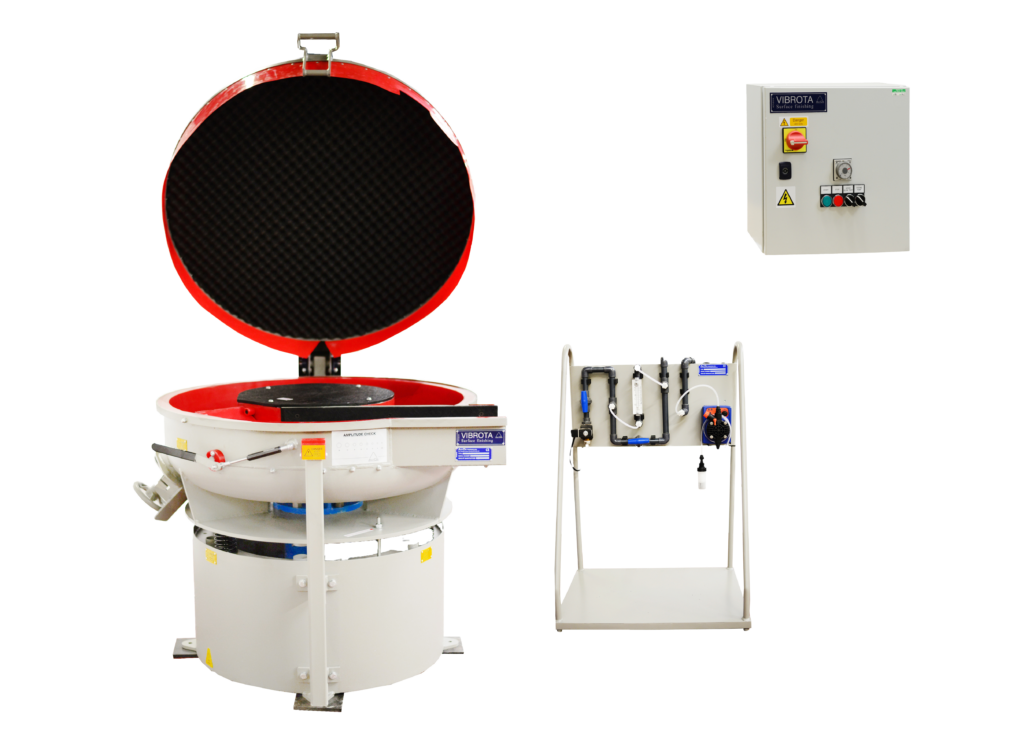
Circular vibrators generate a rotary movement within a circular tub, mixing the parts with abrasives. Predominant on the market for their versatility, affordable cost and ease of use, they adapt to various part shapes, sizes and materials, delivering uniform, high-quality results.
They are perfectly suited to operations such as deburring, polishing, cleaning or finishing metal or ceramic parts.
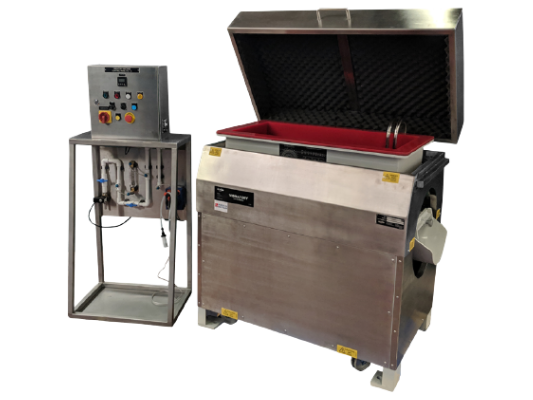
As for linear vibrators, they produce a linear movement in a rectangular tub, where the parts are placed on supports or separated by partitions. These more specialized machines excel at processing long, bulky, heavy or fragileparts, minimizing the risk of damage or scratches. They are ideal for finishing, polishing or ball burnishing work on high-precision parts, used in particular in aerospace, the medical sector or watchmaking.
Specific advantages and applications of mass finishing vibrators
Circular vibrators stand out for their:
- Ease of installation, adjustment and maintenance.
- Economical purchase and operating costs.
- Excellent performance when processing large quantities of parts.
- Compatibility with various abrasives and compounds.
These machines are widely used in sectors such as automotive, mechanical engineering, foundry and many others.
The advantages of linear vibrators include:
- Their power, precision and flexibility.
- High resistance to wear and corrosion.
- Their quiet operation and energy efficiency.
- The possibility of customization according to the dimensions and weight of the parts.
They are used in highly demanding industrial fields such as aerospace, medical, jewelry, watchmaking and optics.
Choosing the technology according to finishing needs
To select the most suitable mass finishing vibrator, consider the following aspects:
- The shape, size, weight, material and fragility of the parts.
- The desired type, intensity, quality and duration of treatment.
- Production volume, frequency and rate.
- The budget, available space and standards to be met.
Generally speaking, circular vibrators are suitable for bulk processing of small to medium-sized, simple, robust parts at moderate cost. Linear vibrators, on the other hand, are preferable for large, complex-shaped, delicate parts processed in small quantities for a high-quality result.
To refine your choice, do not hesitate to consult the technical data sheets of the available models or contact a mass finishing expert for personalized advice and solutions.
Optimizing and maintaining mass finishing vibrators
To guarantee flawless performance, mass finishing vibrators require meticulous maintenance and continuous optimization. This article shares key tips for the effective management of consumables and effluents, as well as thorough preventive maintenance of these machines.
Best practices for maintaining the performance of mass finishing vibrators
Ensure the optimal operation of your mass finishing vibrators with the following best practices:
- Regularly check the level and quality of the process liquid and renew it if necessary.
- Select abrasives and compounds suited to the specific processing needs.
- Maintain adequate filling of the tub to avoid any overloading or underloading.
- Adjust the processing parameters (frequency, amplitude, pressure, temperature) according to the manufacturer’s recommendations.
- Meticulously clean the processing tub and the parts after each cycle, making sure to remove all residues.
Efficient management of consumables and effluents
For responsible management of consumables and effluents, adopt the following strategies:
- Choose high-quality, durable abrasives that generate little dust.
- Favor eco-friendly compounds that respect the environment and operators’ health.
- Implement filtering and recycling systems for the process liquid, in order to minimize water and compound consumption while reducing polluting discharges.
- Use automatic separation and drying systems for efficient recovery of parts and abrasives, thus reducing material waste.
Preventive maintenance to guarantee maximum longevity
Regular preventive maintenance is essential to ensure a long service life for your mass finishing vibrators:
- Visually inspect all elements of the machine (tub, motor, springs, bearings, seals, cables…).
- Identify and repair any anomalies (leaks, abnormal noises, vibrations, overheating…).
- Lubricate moving parts (bearings, gears, chains…).
- Replace worn parts to preserve the machine’s efficiency.
- Carry out operating tests to confirm the optimal condition of the machine and the quality of the treatment.
For effective maintenance, refer to the user manual or contact a competent after-sales service.
Conclusion
In this article, we have explored the world of mass finishing vibrators: their evolution, their comparison criteria, and their optimization and maintenance methods. We hope we have enriched your knowledge of this essential equipment for achieving high-qualitysurface finishes.
If you would like to learn more about mass finishing vibrators or if you need personalized advice on choosing, installing or using these machines, do not hesitate to contact us. As mass finishing experts, and thanks to our partner ActonFinishing , we offer tailor-made solutions designed to meet your specific requirements and respect your budget.
Our commitment does not stop at the sale. We guarantee you a responsive and competent after-sales service, aimed at your complete satisfaction.
Do not miss out on the advantages that mass finishing vibrators offer for the surface treatment of your parts.
Contact us today to get a free, no-obligation quote.
Get a free quote
We will be by your side to support you in your finishing projects.